

When a floor worker cannot read a lockout/tagout instruction or a floor supervisor struggles to explain a changeover, the consequences ripple across every metric a production manager and operations manager track. For the manufacturing industry, communication is not just English - it is an imperative skill that determines whether a company can perform safely and profitably, a key reason why manufacturing plants need English-language training. Investing in Language Training is a key part of a safe and efficient manufacturing business.
Why Manufacturing Plants Need English-Language Training for Employees
Manufacturers contributed $2.33 trillion to the US economy in 2018, and by early 2026, that figure climbed past $3.0 trillion in just the first quarter, according to the National Association of Manufacturers. This continuous growth depends on a workforce where roughly 10.4% of manufacturing workers are born outside of the US - a figure that rises sharply in states like California (33.4%), Texas (23.2%), and New York (27.9%). Across many states, language barriers on the shop floor are a major concern for plant leaders, which is why Language Training Programs offers training throughout the US.
Manufacturing plants need English-language training to avoid a variety of issues. Examples include:
- Misreading work orders or measurement tolerances
- Difficulty reporting defects to a quality manager
- Confusion during safety briefings and shift handoffs
- Miscommunication between receiving, production, and shipping
These gaps show up directly in OSHA recordables, rework rates, scrap percentages, and downtime. Over 43,000 companies now use language programs to solve communication barriers, and effective communication enhances productivity and safety in manufacturing. Language Training Pro designs English-language training programs around real manufacturing tasks - line changeovers, quality checks, hazard reporting - rather than generic ESL content. As a Boston-based provider of customized corporate language training offered nationwide, we build every program to move the KPIs that matter to your team.
Below, we walk through how language training works, how it strengthens manufacturing safety, how it supports career paths, and how to request a free quote.
Manufacturing Plants Need English-Language Training to Strengthen Safety, Quality, and Productivity
English proficiency ties directly to three metrics every plant tracks: safety, quality, and throughput. Research from the National Institute for Occupational Safety and Health (NIOSH) shows that workers with limited English report higher exposure to hazards and are less likely to refuse unsafe conditions. English training improves safety by helping workers understand warnings, read chemical labels, and follow PPE requirements. Safety instructions are a key component of English-language training for manufacturing, and effective training includes listening practice for safety talks and the use of instructional materials. When employees can understand safety warnings and ask clarifying questions, the result is fewer incidents and lower workers' compensation costs.
On the quality side, employees who accurately follow written Standard Operating Procedures (SOPs), interpret tolerances, and communicate defects to supervisors reduce scrap and rework. Consider a food plant where an operator misreads a mixing ratio - the batch becomes scrap. After training, that same operator confirms the instruction with a supervisor before proceeding, saving materials and time.
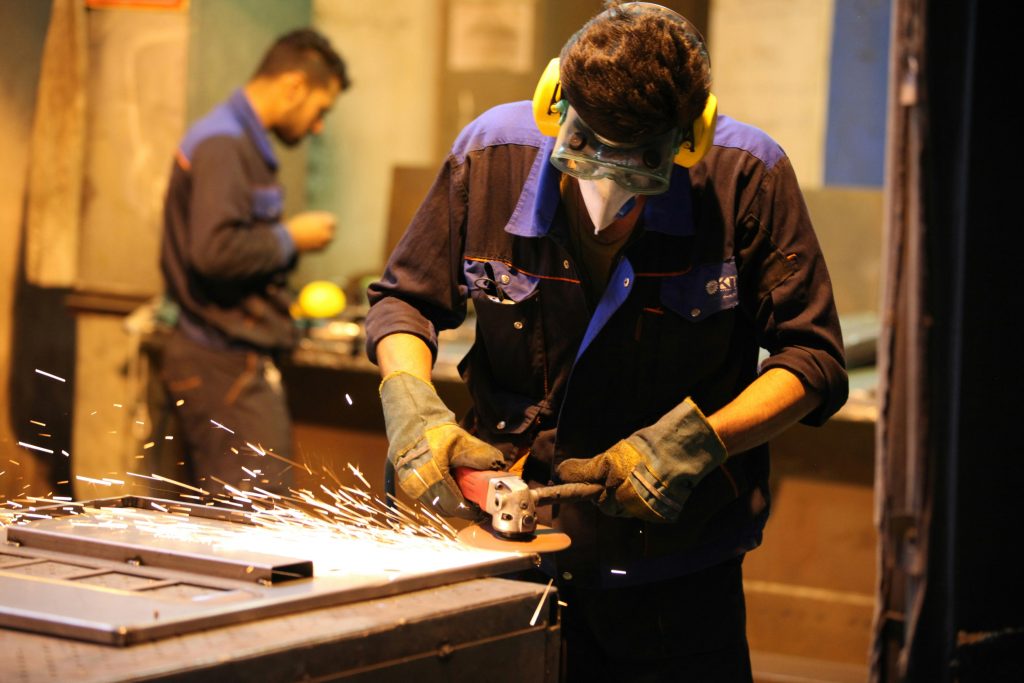
Manufacturing plants need English-language training because productivity gains follow naturally. Clearer instructions reduce onboarding time, minimize changeover bottlenecks, and help employees operate equipment more efficiently. Supervisors and lead operators spend less time repeating instructions or translating and more time on process improvement. Effective communication reduces conflict and increases workplace engagement across every shift. Language Training Pro aligns course content with OSHA requirements and customer quality standards, ensuring employee training reinforces programs already in place—investing in language training helps your business stay compliant and perform at the top of its game.
What an English-Language Training Program for Manufacturing Employees Looks Like
A typical manufacturing-focused language training program from Language Training Pro runs 8–16 weeks with 1–3 sessions per week, delivered on-site or live online via Zoom. Programs targeting job-specific communication are more effective than general ESL, which is why every engagement starts with a needs analysis: level testing for workers, interviews with HR and safety managers, and a review of plant documentation such as SOPs, safety manuals, and work instructions.
Courses include 14 lessons for manufacturing language skills. Each lesson has multiple activities to practice language skills through exercises that mirror daily activities on the floor. Courses also include 23 vocabulary terms for manufacturing communication, with lessons featuring vocabulary terms with definitions and context drawn from actual plant documents. Using real workplace materials boosts vocabulary retention in English training, helping language learning stick.
Many manufacturers adopt blended learning approaches combining various training formats. All courses are delivered by experienced instructors using a communicative, interactive approach - students speak and practice in every class. Flexible scheduling options (before shift, after shift, during paid training hours) and small-group or individual coaching ensure production demands are met.
Investing in Language Training for Specific Roles in the Manufacturing Industry
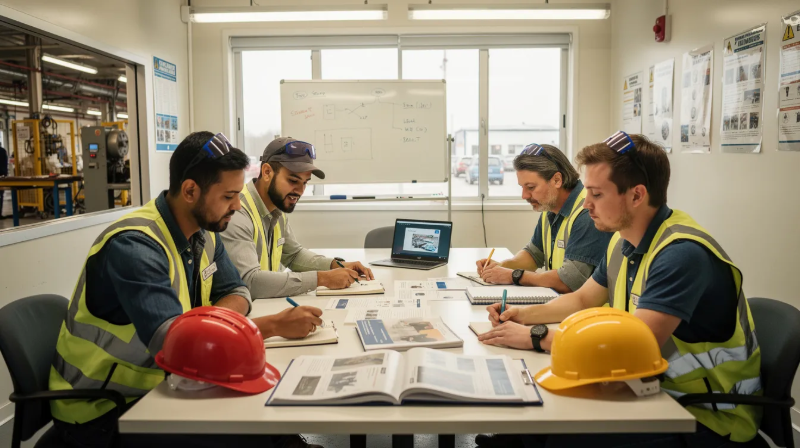
A modern plant is not homogeneous. Frontline operators, maintenance technicians, quality inspectors, warehouse staff, and team leads each need different English courses. Tailoring ESL training to specific manufacturing environments leads to better outcomes, and bilingual employees can benefit from customized training programs catered to specific job roles.
Language Training Pro creates role-specific modules using real documents from each role:
- Machine Operation & Safety Checks - operators learn to operate machines correctly and read parameter sheets
- Incident and Near-Miss Reporting - writing and vocabulary for documenting problems
- Warehouse & Logistics Communication - pick tickets, bills of lading, shipping paperwork
- Quality Inspections & Defect Descriptions - industry-specific vocabulary for nonconformance reports
Investing in language training builds knowledge of industry-specific vocabulary and improves workplace communication, helping reduce conflict and increase engagement. Integrated technical skills training enhances English learning in manufacturing, and active communication practice improves English skills in manufacturing workplaces. Lessons blend vocabulary, listening, speaking, reading, and writing in work-related contexts - shift handoff conversations, maintenance requests, and problem-solving discussions. Manufacturing develops skills workers need when exercises include role-play dialogues, form-completion practice, and fill-in-the-blank instructions based on real work orders.
Supervisors can join sessions to model the language used in pre-shift talks or safety stand-downs, which has helped manufacturing workers build confidence and communicate more naturally with their teams.
Implementation and ROI
Launching a manufacturing English-language program follows a clear roadmap:
- Discovery call - discuss plant goals, workforce size, and languages spoken
- Free quote - proposed format (on-site or online), estimated hours, sample curriculum, and pricing
- Needs analysis - proficiency assessments, document review, supervisor interviews
- Pilot group - launch with one line or department
- Full rollout - scale across shifts and plants with regular progress reporting
Manufacturing plants need English-language training because it boosts both productivity and efficiency. Research on apprenticeship programs incorporating communication skills shows a return of approximately $1.48 per $1 invested, and the ROI for language training follows a similar pattern: reduced safety incidents, fewer language-related errors, faster onboarding, and improved retention. Workers possess stronger skills, and improved communication diminishes conflict across departments. The result is a productive work environment where problems are addressed in real time, not after costly mistakes.
Regular monitoring of language development helps identify areas for improvement in training. Language Training Pro provides attendance tracking, pre- and post-training assessments, and supervisor feedback - giving your team concrete evidence of progress. State workforce training grants may offset costs; our language training department can help you identify funding in your state. This helps make investing in language training more affordable for those who qualify.
Investing in Your Plant's Future
Improving productivity at a global level starts on your shop floor. Your manufacturing workers' English proficiency is among your company's most powerful assets - and your people are your most important asset. When a company decides to start investing in language training, professionals at every level can communicate clearly, serious problems shrink, and efficiency rises. Manufacturing plants need English-language training because any shift without clear communication puts safety, quality, and throughput at risk.
To start investing in language training with Language Training Pro? For more information, contact us at +1 (617) 731-3700, email training@languageconnections.com, or request a free quote online - no obligation, customized to your plant.


