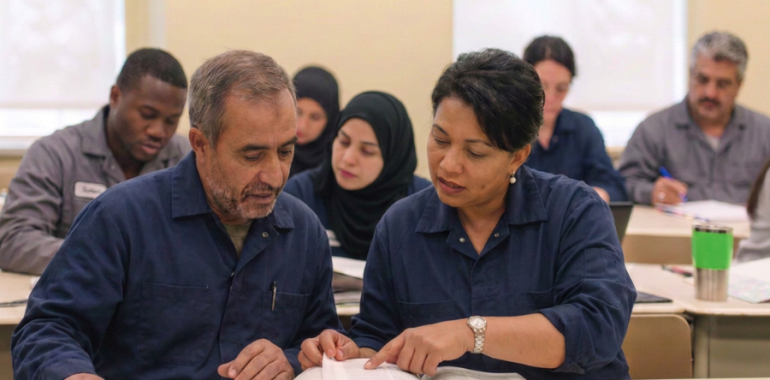
Manufacturers across Massachusetts's South Coast region — the stretch of Bristol County anchored by New Bedford and Fall River — share a common challenge: building a stable, safe, and productive workforce in communities where English is often a second or third language. For HR leaders and operations managers running plants in these cities, corporate English training isn't a nice-to-have. It's a direct lever on safety, quality, and retention.
If you've searched for English training for manufacturing employees in New Bedford or Fall River, here's what that actually looks like on the ground — and how to fund it.
Why English Training Matters on the South Coast Manufacturing Floor
New Bedford and Fall River carry deep manufacturing legacies built on generations of immigrant labor. New Bedford's economy grew out of whaling and fishing; Fall River rose as a textile powerhouse. Both cities still depend on a workforce shaped by that history: long-established Portuguese-speaking communities (many with Azorean roots), Cape Verdean Creole speakers concentrated in seafood processing and production roles, and a growing Spanish-speaking population working across shifts. According to the U.S. Census Bureau's QuickFacts data for New Bedford, roughly one in four residents identifies as Hispanic or Latino, and close to 38% of residents speak a language other than English at home — a snapshot of just how central multilingual workers are to the local labor pool.
That diversity is a real strength for manufacturers, but only when language differences don't stand between employees and the training, safety instructions, and career growth they need. Left unaddressed, the gaps show up as concrete operational problems:
- Misunderstood lockout/tagout procedures and emergency instructions
- Confusion over quality specs, gauge measurements, and acceptable tolerances
- Difficulty reading standard operating procedures, safety data sheets, or maintenance manuals
- Workers held back from line-lead, operator, or maintenance roles by limited English — not limited skill
- Higher turnover when employees feel unable to fully participate on the floor
English training directly affects the metrics HR and operations teams already track: first-pass yield, rework rates, injury frequency, and retention.
What Corporate English Training Looks Like for a South Coast Manufacturer

Language Training Pro builds programs specifically for industrial and manufacturing environments, not generic classroom ESL. A few of the ways South Coast manufacturers typically get started:
- Corporate language training — a full program overview showing how training is structured around your shift schedules, employee skill levels, and business goals.
- Corporate English training built around industry-specific vocabulary, so employees learn the exact terms used on your floor — machine names, safety commands, quality specs — instead of textbook English they'll never use at work.
- English training for employees delivered as an ongoing benefit that builds day-to-day confidence with supervisors and coworkers.
- English classes for companies that scale from a single-department pilot to a plant-wide rollout.
- Comprehensive language training programs spanning entry-level onboarding English through advanced business communication for employees moving into leadership.
- Online ESL training for manufacturers running multiple shifts, so training doesn't require pulling people off the line during production hours.
Programs typically include tiered course levels (beginner ESL for new hires, intermediate workplace English for experienced operators, advanced business English for supervisors and team leads), department-specific class groupings, and flexible formats — on-site in a plant training room, hybrid, or fully virtual for multi-location employers. Classes can be scheduled before or after shifts, or during paid training blocks, so production targets aren't disrupted.
How Much Does Corporate English Training Cost?
Cost depends on class size, format, and how much of the curriculum needs to be customized to your specific job roles — but South Coast manufacturers rarely have to cover the full cost themselves, because state and federal workforce grants are available to offset it. That's where MassHire Greater New Bedford comes in.
What Funding Is Available Through MassHire Greater New Bedford?

MassHire Greater New Bedford is the region's workforce development board and career center, serving Acushnet, Dartmouth, Fairhaven, Freetown, Lakeville, Marion, Mattapoisett, New Bedford, Rochester, and Wareham. Its employer services include hiring assistance, apprenticeships, and — most relevant here — Incumbent Worker Training support and access to the state's Workforce Training Fund Program (WTFP).
The WTFP, administered by Commonwealth Corporation on behalf of the Commonwealth of Massachusetts, is a strong fit for English training specifically. Per a Massachusetts state government funding announcement, General Program grants are competitive, two-year awards ranging from $10,000 to $250,000 that pay for customized training for current employees, with employers contributing a matching investment (which can include wages paid to employees during training hours). MassHire Greater New Bedford can help identify whether this or another grant fits your plant, and its programs and services are also funded in part through U.S. Department of Labor (DOL) Employment and Training Administration (ETA) grants under the federal Workforce Innovation and Opportunity Act (WIOA).
Reach out to MassHire Greater New Bedford for:
- Identifying which grant programs your company may qualify for
- Understanding eligibility and match requirements for incumbent-worker training funds like the WTFP
- Connecting your training plan — such as a program built with Language Training Pro — to available funding streams
The MassHire Greater New Bedford Career Center is located at 25 Elm Street, New Bedford, MA 02740. Start there before committing budget to a training program, since grant eligibility can shape how a program gets structured and scheduled.
Getting Started
The most effective approach combines both resources: MassHire Greater New Bedford as your local funding and grant contact, and Language Training Pro as the training provider that actually delivers results on your production floor. Start by contacting MassHire to explore funding eligibility, then bring in Language Training Pro to design a program matched to your industry, your shift patterns, and the specific mix of Portuguese, Cape Verdean Creole, and Spanish speakers on your team.
Closing the language gap isn't about checking a compliance box. It's about building a South Coast manufacturing workforce that's safer, more skilled, and more likely to stay.
Contact Language Training Pro for a tailored proposal that aligns with your production goals and quality requirements. Request a free quote online - no obligation, customized to your plant.
Frequently Asked Questions
Does OSHA require workers to speak English?
No. The Occupational Safety and Health Administration (OSHA) does not require employees to speak English, but it does require that safety training be delivered in a language and vocabulary employees can understand. For manufacturers with Portuguese-, Cape Verdean Creole-, or Spanish-speaking staff, that means either bilingual safety materials or corporate English training that gets employees to a level where they can fully follow safety instructions.
How much does corporate English training cost for a manufacturer?
Cost depends on class size, delivery format, and how customized the curriculum needs to be to your specific equipment and job roles. Many South Coast manufacturers offset some or all of the cost through grant programs like the Massachusetts Workforce Training Fund Program, administered with support from MassHire Greater New Bedford.
Can English training be scheduled around shift work?
Yes. Corporate providers like Language Training Pro typically schedule classes before or after shifts, during paid training blocks, or fully online so multi-shift manufacturers don't lose floor coverage during production hours.
Who is eligible for MassHire Greater New Bedford training grants?
Eligibility depends on the specific grant program. MassHire Greater New Bedford can walk manufacturers through requirements for incumbent-worker training funds, including the Workforce Training Fund Program, which requires a matching employer investment that can include wages paid during training.
Do employees need to already speak some English to join a corporate
No. Programs are typically tiered, starting with beginner ESL for new hires and building toward intermediate workplace English and advanced business English for supervisors and team leads, so employees at any starting level have a path forward.


