Close Language Gaps on Your Farm or in the Field
We work directly with HR and operations leaders at large farms, agribusiness companies, and food production operations to close language gaps across seasonal and year-round agricultural workforces. See how we serve agriculture and other industries with large multilingual workforces.
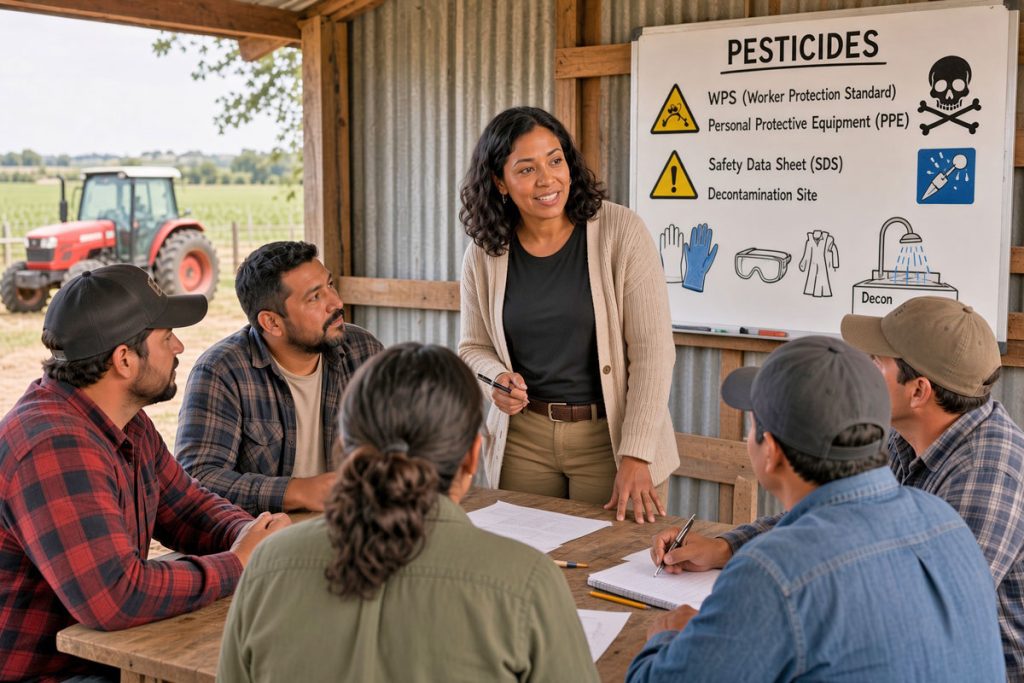
Corporate English training for farmers creates understanding and trust — both within your crew, and between your farmhands and the people they work with. Most on-the-job accidents in farming and agriculture involve heavy equipment, pesticide handling, or a miscommunication in direction. When farmhands can't fully understand what's being asked of them in a high-risk environment, the likelihood of an on-the-job accident increases substantially. Our English training for agricultural workers addresses communication problems at the root — before they become an expensive lawsuit instead of an avoidable conversation.

The Language Gap, By the Numbers
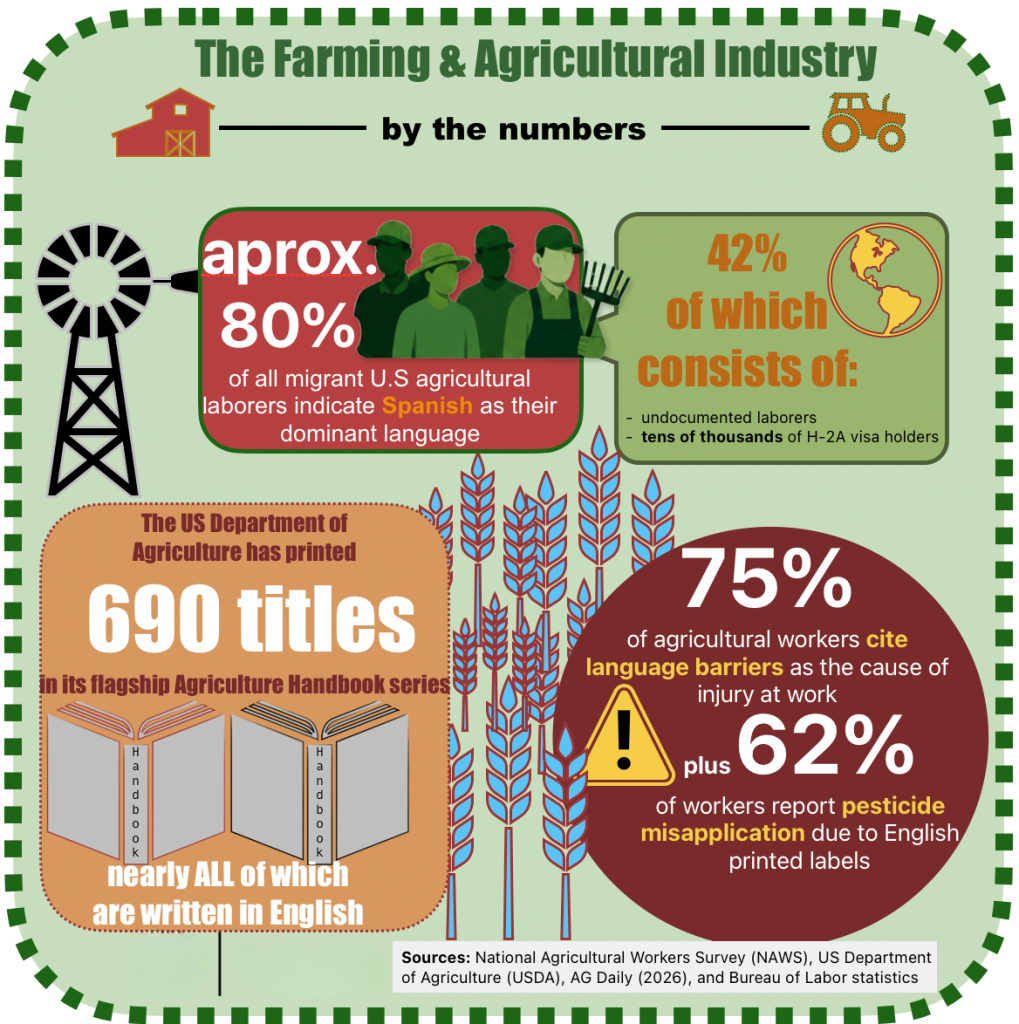
According to the National Agricultural Workers Survey, roughly 80% of migrant U.S. agricultural laborers report Spanish as their dominant language, and 75% cite language barriers as a contributing cause of workplace injury. 62% report pesticide misapplication linked to English-only warning labels. These aren't small-scale problems — they're systemic gaps that directly affect safety, compliance, and your bottom line.
Built for Farms and Agribusiness, Not Off-the-Shelf ESL
- Custom curriculum built around the actual language of your operation — safety manuals, pesticide labels, equipment SOPs — not generic textbook English
- Flexible scheduling around planting, harvest, and seasonal labor cycles, including onsite classes at your farm or live online classes for distributed teams
- OSHA safety training in English, so Spanish-speaking and other non-native-English crews fully understand hazard warnings, equipment protocols, and emergency procedures
- Real, live instructors — not an app — combining the convenience of remote learning with the quality of in-person teaching
- Regular progress reports, so you can see what's working and adjust pacing based on real results, not just attendance
Our Process
- Initial consultation with your HR and department heads to identify your priorities — reducing accidents, improving compliance, or something else
- Job-task analysis — we review your safety manuals and SOPs to identify the exact vocabulary your crew needs
- Free proficiency assessment for each participant, so we can group workers by skill level
- Custom curriculum design, built around your actual operation, not a generic template
Workers Spread Across Multiple Farms? Online Classes Solve That
Agricultural labor doesn't always stay in one place. Crews often move between multiple farms or properties depending on the season, the crop, or the day's assignment — which makes it hard to get everyone into the same room for in-person training. Live online classes with a real instructor solve this directly: workers can join from wherever they're working that day, on a phone or shared device, without anyone needing to travel to a central training location or wait for a full crew to be onsite at once.
This also means you're not limited to training one property at a time — workers from multiple farms under the same ownership, or seasonal crews contracted across several locations, can join the same class and progress together, even if they never physically work side by side.

Massachusetts Employers — You May Qualify for Grant Funding

If your farm or agricultural business is based in Massachusetts, you may be eligible for funding assistance through the Workforce Training Fund Program (WTFP).
WTFP is state grant program that can reimburse a significant portion of your training costs — including ESOL/workplace English training.
We can help you navigate the application process. (This program is specific to Massachusetts-based employers; it does not apply outside MA.)
Why Invest in English Training for Your Agricultural Workforce
- Improved safety — fewer accidents tied to miscommunication around equipment and hazards
- Increased efficiency — clear instructions mean fewer mistakes and less rework during time-sensitive planting and harvest windows
- Employee retention — workers who feel invested in are more likely to stay
- Reduced legal and compliance risk — avoid the costly aftermath of preventable, communication-related accidents
See the full case for investing in your workforce on our Why Invest in Language Training page.
Our English Training On-site and Online Corporate Language Training programs are available nationwide. Get a Free Quote for your farm or agricultural operation today, or see our Industry-Specific Courses page. Looking for food processing or meatpacking teams specifically? See our English for Food Processing, Meatpacking & Poultry program.
Frequently Asked Questions
Do you offer English training for seasonal and migrant farm workers?
Yes. We build programs around the realities of seasonal agricultural labor, including flexible scheduling around planting and harvest cycles.
Can training help with pesticide and equipment safety compliance?
Yes. Our programs are built around your actual safety protocols and equipment procedures, helping ensure every worker can understand and follow critical safety instructions.
Do you work with large farms or multi-site agribusiness companies?
Yes. We support single-farm operations as well as large, multi-site agribusiness companies, with training delivered onsite or online, coordinated by one dedicated account manager.
Can training be customized to our specific crops, livestock, or equipment?
Yes. We start with a needs assessment and build vocabulary directly from your actual operations, rather than generic ESL content.
Do you offer both onsite and online training for agricultural teams?
Yes. We offer onsite, instructor-led training scheduled around your season, as well as live online classes for distributed teams.
Can workers from different farm locations join the same class?
Yes. Since agricultural crews often move between multiple farms or properties, live online classes let workers join from wherever they're working that day — no need to travel to a central location or wait for a full crew to be onsite at once. Workers from multiple farms under the same ownership, or seasonal crews contracted across several locations, can even join the same class together.