
Safety is the first letter on every Safety, Quality, Delivery, and Cost (SQDC) board in your plant, and for many Massachusetts manufacturers, one of its least-examined root causes is language. When an operator can't fully read a lockout procedure, a chemical label, or the updated standard work posted at the cell, the gap rarely shows up in the incident report as "language." It shows up as "did not follow procedure."
The good news for operations and quality leaders: Massachusetts offers grant funding that can cover much of the cost of fixing that root cause. An OSHA safety English training grant for manufacturing in Massachusetts typically flows through Workforce Innovation and Opportunity Act (WIOA) incumbent worker funds or the state's Workforce Training Fund Program (WTFP). Used well, that funding lets you run corporate language training as a safety and process-control investment rather than a discretionary perk.
This article explains how English for Speakers of Other Languages (ESOL) instruction connects to Occupational Safety and Health Administration (OSHA) expectations, where the funding comes from, and how to measure the results with the metrics you already track.
Why Safety Is an Operations Problem, Not Just an EHS Problem

A recordable incident is a process failure with a human cost, and it behaves like every other defect on your floor. It stops the line, pulls supervisors off the gemba, triggers investigations and corrective actions, and erodes the stability that lean systems depend on. In cost of poor quality (COPQ) terms, it belongs in the same conversation as scrap, rework, and unplanned downtime.
Lean practice already treats standard work as the foundation of both safety and quality. The National Institute of Standards and Technology (NIST) Manufacturing Extension Partnership (MEP) describes lean and process improvementas a way to eliminate waste and build more reliable processes. But standard work only holds if every operator can read it, understand it, and ask questions about it. If a meaningful share of your workforce is still building English proficiency, your standard work is only as strong as their comprehension.
That is why corporate English training built around your own procedures functions like any other countermeasure in a Plan-Do-Check-Act (PDCA) cycle. It targets a root cause, not a symptom.
Where Language Gaps Hide in Your Safety Systems
Language gaps rarely announce themselves. Operators nod through a toolbox talk, sign the training roster, and return to work. The gap surfaces later, at the points where your safety system depends on reading, listening, or speaking up:
- Lockout/tagout (LOTO) procedures. Machine-specific energy control steps are dense, sequential, and unforgiving of a misread word.
- Hazard communication. Safety Data Sheets (SDS) and container labels use technical vocabulary that everyday conversational English does not cover.
- Signage and visual management. Pictograms help, but warning text, floor markings, and andon instructions still carry critical detail.
- Job safety analyses (JSAs) and work instructions. Updated procedures only reduce risk if operators understand what changed and why.
- Shift handoffs and near-miss reporting. An operator who can't confidently describe a hazard is less likely to report it, which starves your leading indicators.
Effective English training for employees targets exactly these moments. Unlike general English classes for companies, a safety-focused curriculum builds vocabulary and confidence around the documents and conversations your plant actually uses.
What OSHA Expects: Training Workers Can Actually Understand
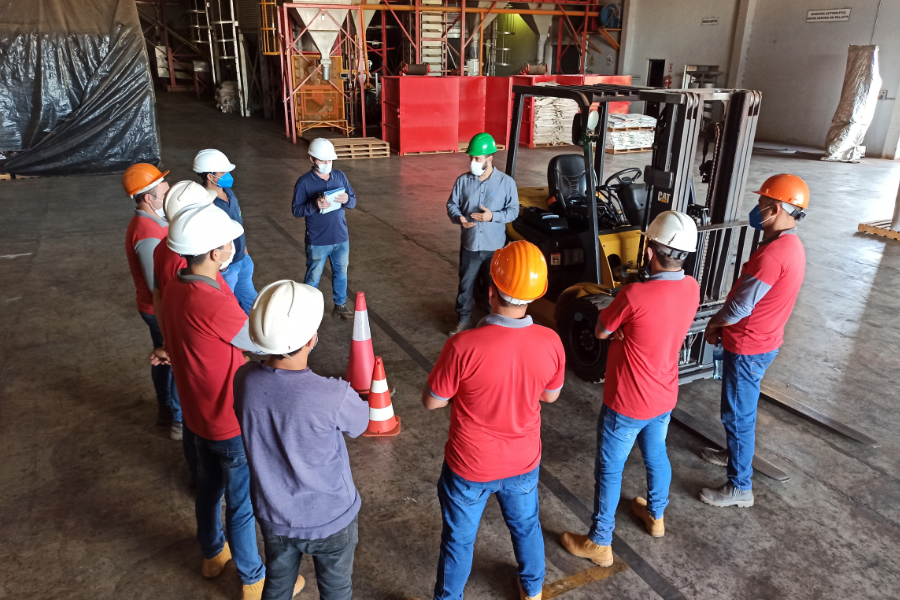
OSHA's position is that required safety training must be delivered in a language and vocabulary employees can understand. Handing a worker a translated sign-off sheet, or running a class they sat through but could not follow, does not meet that expectation.
For operations leaders, the practical question is how to close the gap sustainably. Translating every document into every language on your floor is expensive and hard to keep current as procedures change. Building workers' English proficiency, especially around safety and process vocabulary, strengthens every future training session, toolbox talk, and procedure update at the same time.
ESOL training is not a substitute for OSHA-required safety training or for translated materials where they are needed. It is a complement that makes all of your safety training more effective. Your Environmental, Health, and Safety (EHS) lead should confirm how any program fits your specific compliance obligations.
Flexible formats help here too. Online ESL training can fit around shift schedules, so English as a Second Language (ESL) instruction does not have to compete with production for floor time.
How Massachusetts Funds Workplace English Training
Massachusetts employers generally access ESOL funding through two channels. Both can support language training programs for your current workforce, and many employers use "WIOA" as shorthand for either one.
| Funding path | Administered by | What to know |
|---|---|---|
| WIOA Title I incumbent worker training | Regional MassHire Workforce Boards | Federal funds for upskilling existing employees; availability and rules vary by region, so start with your local board. |
| Workforce Training Fund Program (WTFP) | Commonwealth Corporation | State-funded grants for Massachusetts employers; names ESOL as a funding priority under both its Express and General programs. |
The WTFP Express program is generally the simpler route for smaller employers choosing from pre-approved training options, while the General program supports larger, customized training plans. Eligibility, match requirements, and application windows change, so confirm current details directly with Commonwealth Corporation or your MassHire board before you plan a budget around them.
From an operations standpoint, the key point is that grant funding shifts the cost-benefit math. A countermeasure you might have deferred for budget reasons can move to the top of your improvement list.
What a Safety-Focused English Program Looks Like on the Floor
The most effective programs are built from your plant's own materials, not a generic textbook. Language Training Pro designs courses around the documents and conversations your operators encounter every shift. A safety-focused program typically includes:
- A needs assessment. Identify which roles, procedures, and communication points carry the highest risk, much as you would scope a kaizen event.
- Proficiency testing. Establish a baseline for each participant so instruction matches their level and progress can be measured.
- Plant-specific curriculum. Use your actual LOTO procedures, SDS, signage, work instructions, and SQDC board language as teaching material.
- Speaking and reporting practice. Build confidence in describing hazards, asking clarifying questions, and reporting near misses.
- Scheduling that protects throughput. Offer on-site, virtual, or blended sessions timed around shifts and changeovers.
- Progress reporting. Provide documentation that supports both your internal review and your grant reporting obligations.
Measuring the Impact with Metrics You Already Track
You don't need a new dashboard to evaluate an English training program. Tie it to indicators already on your tier boards:
- Leading safety indicators: near-miss reports submitted, safety observations completed, and participation in toolbox talks.
- Lagging safety indicators: recordable incidents and first-aid cases in the areas where participants work.
- Standard work adherence: layered process audit (LPA) findings related to procedure compliance.
- Quality and cost signals: scrap, rework, and nonconformances traced to misunderstood instructions.
- Training effectiveness: first-pass comprehension on new or revised procedures.
Track a baseline before training begins and review trends at regular intervals, just as you would for any countermeasure.
Hypothetical example: Imagine a plastics molder in central Massachusetts where near-miss reporting is consistently lower on the shift with the most multilingual operators. The plant manager suspects operators are not confident describing hazards in English. Using WTFP funding, the plant runs a program built around its own LOTO procedures and hazard-reporting forms, then tracks near-miss submissions and LPA findings on that shift against the pre-training baseline. This scenario is illustrative only and does not describe a real company or real results.
Turn Grant Funding into a Safer, More Stable Operation
If language is a hidden root cause behind procedure deviations, missed near-miss reports, or uneven standard work on your floor, grant-funded English training is one of the most cost-effective countermeasures available to Massachusetts manufacturers. Language Training Pro builds plant-specific programs that support your safety, quality, and continuous-improvement goals, and can help you align the program with WIOA or WTFP funding.
Request a free quote to scope a program for your plant.
Frequently Asked Questions
Can Massachusetts grant funds pay for English training focused on safety?
Yes, in many cases. The Workforce Training Fund Program names ESOL as a funding priority, and WIOA incumbent worker funds can support skills training for current employees. Confirm eligibility and allowable costs with Commonwealth Corporation or your regional MassHire Workforce Board.
Does English training replace OSHA-required safety training?
No. ESOL training complements required safety training by helping employees understand it. You still need to deliver OSHA-required training in a language and vocabulary workers understand.
What is the difference between WIOA and WTFP funding?
WIOA Title I incumbent worker training uses federal funds administered by regional MassHire Workforce Boards. The WTFP is a state-funded program administered by Commonwealth Corporation, with Express and General grant options.
How do we schedule training without hurting throughput?
Programs can run on-site, online, or in a blended format and be timed around shifts, breaks, and changeovers. Online sessions are especially useful for multi-shift operations.
Who in the plant should own the program?
Ownership works best with operations or continuous-improvement leaders, in partnership with EHS and HR. Treating it as a countermeasure with measurable outcomes keeps it tied to production goals.
How do we know if the training is working?
Set a baseline for metrics such as near-miss reporting, LPA findings, and procedure-related nonconformances, then track trends as training progresses. Participant proficiency testing adds a direct measure of language gains.


