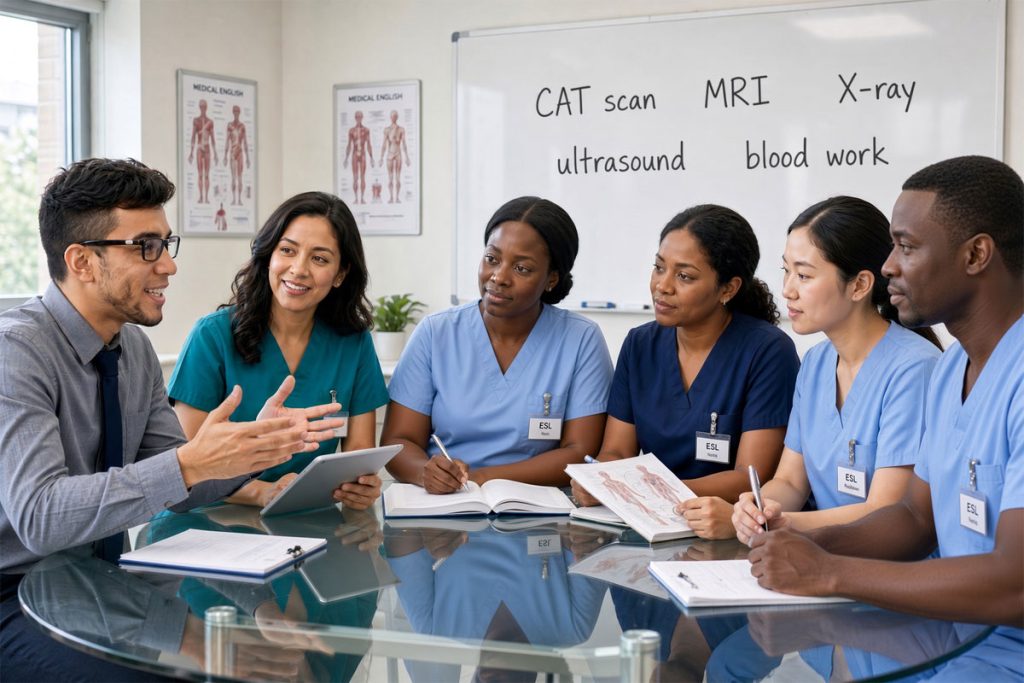
Medical English for Healthcare Professionals
Hospitals and health systems increasingly rely on foreign-trained nurses, CNAs, medical assistants, and support staff to fill critical workforce gaps. When English isn't a first language, small communication gaps can affect patient safety, team coordination, and staff confidence.
Language Training Pro's Medical English for Healthcare Professionals program gives your workforce the vocabulary, pronunciation, and real-world communication skills they need to work confidently with patients, physicians, and coworkers — delivered onsite at your facility or online, on a schedule built around shift work.
Why healthcare employers choose this program:
- Built specifically for hospitals, clinics, long-term care facilities, and staffing agencies — not a generic ESL class
- Improves patient-safety communication and reduces costly misunderstandings
- Increases retention and promotion readiness for immigrant staff
- Flexible group or individual formats that work around clinical shift schedules
- Delivered by trainers experienced in industry-specific corporate language training

Built for Healthcare Roles at Every Level

This course is designed for the full range of staff your organization depends on: doctors, nurses, CNAs, medical assistants, scientists, physical therapists, and other clinical and support professionals who need to communicate clearly with patients and coworkers.
See how this fits into a broader workforce strategy on our Industries Served page, or explore Why Invest in Language Training for the ROI case to bring to leadership.
Medical English — 5 Areas of Language Competency
Our curriculum focuses on the five competencies most critical to safe, effective communication in a clinical setting:
- Vocabulary Building
- Speaking
- Pronunciation
- Grammar
- Writing

Practice-Based Learning for the Healthcare Setting
Our Medical English course uses interactive, role-based learning so staff can apply new vocabulary immediately on the floor — not just in a classroom.
Course activities include: Role-plays · Speaking exercises · Listening comprehension · Multiple choice · Gap fill · Writing · Reading
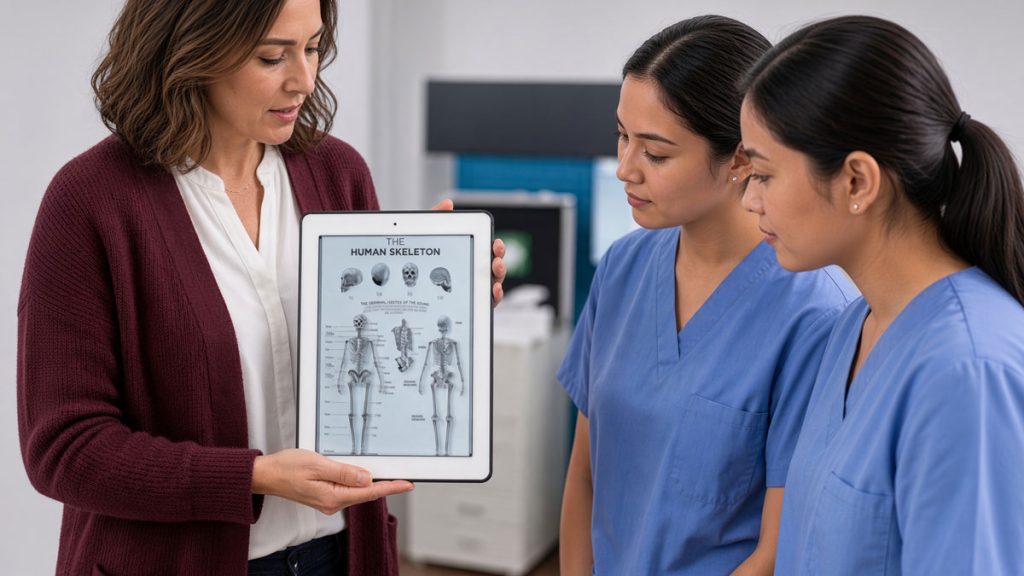
Vocabulary is taught systematically, starting with medical terminology, prefixes, and suffixes, then moving body system by body system — from simple to complex — so staff build a working clinical vocabulary they can use immediately with patients and care teams.
Course Curriculum
Core modules:
- Introduction to American Health Care & Cultural Concepts of Health and Wellness
- The Musculoskeletal System
- The Cardiovascular System
- The Respiratory System
- The Gastrointestinal System
- The Neurological System
- Wounds, and Viral & Bacterial Infections
- Pharmacology and Medication Administration
Additional modules available: Medical English & Communication Barriers · The US Health Care System · Clinical Decision Making · The Influence of Culture in Health Care · Professional Skills & Growth · External and Internal Anatomy · Obstetrics and Gynecology · Male Urinary System · Pediatrics · Dermatology · Eye and ENT · Endocrine System · Oncology, Radiology/Nuclear Medicine · Mental Health
A Complete Language Solution for Healthcare Organizations
Many healthcare employers pair this program with our Medical Interpreter Training Program to build both English proficiency and interpreter capacity across their workforce, or with Medical Spanish Training for clinical staff who need Spanish-language patient communication skills.
Training is available onsite at your facility or through online corporate language training, with locations and formats detailed on our Training Locations page.
Frequently Asked Questions
What is Medical English training for healthcare professionals?
A specialized ESL program that teaches the clinical vocabulary, pronunciation, and communication skills healthcare staff need to work safely and effectively with patients and coworkers.
Which healthcare roles is this program designed for?
Doctors, nurses, CNAs, medical assistants, scientists, physical therapists, and other clinical or support staff who interact with patients or care teams in English.
How does this training reduce risk for hospitals and health systems?
By strengthening staff communication around symptoms, procedures, and medication instructions, the program helps reduce the miscommunication that contributes to errors and patient dissatisfaction.
Can training be delivered onsite at our facility?
Yes. Programs are available onsite, online, or in a hybrid format, and scheduled around shift work and departmental needs.
Do you offer related training like medical interpreting or Medical Spanish?
Yes — many healthcare clients pair this program with our Medical Interpreter Training or Medical Spanish for Healthcare Workers courses.
Ready to strengthen communication across your healthcare workforce? Contact our Language Training Department for a customized program built around your staff and schedule.