
Workforce language training is an essential investment for medical device manufacturing companies. Primarily because this is an industry where precision, regulatory compliance and patient safety all depend on effective communication. Secondly - though just as important- the medical equipment manufacturing industry is one where even the smallest of misunderstandings can have serious consequences. So of course workforce language training is a practical and vitally important investment for the medical device industry- one of the most powerful manufacturing sectors in the United States. Keep reading for a closer look!
A workplace language barrier creates challenges for medical device manufacturing
Issue: Medtech manufacturing workforce has a U.S labor shortage
According to a 2026 report by Manufacturing Lead Generation, currently there are 519,000 medtech manufacturing jobs. All of which require high regulatory oversight. Because medical device production is directly tied to patient safety, clear professional communication on the production floor is increasingly important. Yet 68% of the medical device manufacturing industry is reporting labor shortages.
According to 2026 statistics from zipdo, the millennial generation represents nearly 35% of the current medical device manufacturing workforce. Simultaneously, half of all USA medical device companies are planning to implement A.I in the next two years. Which for manufacturing companies, means that training and upskilling employees is now essential for expected to incorporate it into their roles. Meanwhile, most companies want to shift production back to North America, and 63% plan to reduce dependence on China. All of these strategic moves demand upskilling and training employees.
Solution: Upskill existing medtech manufacturing workforce
Manufacturing workforce language development trainings help everyone feel confident, engaged and committed to their jobs. By investing in workforce language training, medical device manufacturing owners empower their employees to participate more fully. By emphasizing real language in your real workplace, every worker feels a larger sense of belonging and more confident in their roles which leads to a more stable workforce.
Issue: The safety risks of language barriers in medical device manufacturing
In 2025 a research company called Relay conducted a study of 200 manufacturing and warehousing professionals. Finding that 45% of total manufacturing workers believed their plant or site is negatively impacted by language barriers. Even more telling, the study also found that 86% of bilingual respondents cited productivity losses due to communication issues. So, what do language barriers cost? Here's a few figures:
- Bilingual workers spend an average of 4 hours per week for various translating requests costing an additional $7,500 annually for each bilingual employee
- On average, workflow delays cost approximately $1,800 annually for each LEP worker - or one who is Limited English Proficient
Solution: Avoid costly lawsuits & invest in customized language training
The last thing anybody wants is an accident. But failing to prepare is preparing to fail. The reality is that 20% of all workplace accidents happen in factories. In the event of an emergency, your manufacturing employees need to be prepared. Your workforce should know standard vocabulary to describe machinery and standard protocol to operate them. That's why our corporate English training for medtech manufacturing workers centers around practical, everyday language. Including OSHA safety trainings and conversing with first responders. Does your manufacturing team know how to respond to questions like:
- "Where is your defibrillator?"
- "When did you start chest compressions?"
- "Does your guest use an Epi-pen?"
- "What are their vital signs?"
Your associates definitely don't need a highly specialized level of vocabulary, but these are all questions that first responders will ask. And each one of your employees should know basic first aid terminology and be able to answer these questions in English should a rescue event be required on your property.
What will medical device manufacturing employees learn with our professional workforce language training?
EXAMPLE CURRICULUM:
| Example Week: | Example Focus: | Example Topics: | Role or task oriented vocabulary associated with: |
| Week 1: | Foundations for your workplace communication | * Industry, company & task vocabulary * Understanding daily responsibilities, essential tasks & protocols * Understanding instructions and responsibilities at work | * Your clock-in & out system * Your production line * Your machinery, inventory, operations & protocols * Your departments and responsibilities by department or role |
| Week 2: | Production line communication | * Asking for help or clarification * Communicating with coworkers & managers * Reporting production issues * Food safety & reporting issues or concerns | * Starting & stopping procedures * Asking questions related to tasks * Asking for deadline adjustments * "Life cycle" from start to finish of your production line |
| Week 3: | Safety standards | * Communicating sanitation concerns * Reporting malfunctions * Safety & equipment protocols | * Handling standards and procedures * Malfunction issues * Procedure standards |
| Week 4: | Equipment safety and operation | * Reporting issues with machinery and equipment * Maintainence instructions & procedures * Describing mechanical issues | * Machinery issues, warnings & malfunctions * Machine jams and errors * Requesting maintenance and repairs |
| Week 5: | Workplace safety communication | * Managing timed deadlines and workload * Clarifying safety procedures for new tasks and responsibilities * Asking for help | * Protective equipment * Safety hazards * Calling emergency stops * Emergency situation protocols |
| Week 6: | Quality control communication | * Communicating with QA teams * Understanding inspection instructions * Describing product issues | * How to handle a defective product * Explaining errors and how to correct them * Inspection reports * Understanding correction instructions |
| Week 7: | Team collaboration & shift coordination | * Communication protocols for your workplace * Requesting shift changes * Giving updates to coworkers | * How to request a shift or schedule change * Knowing who to ask for help and how to ask professionally * Updating appropriate people on production targets |
| Week 8: | Real world practice | * Role-play real workplace scenarios * Acknowledging communication barriers & correcting them * Building confidence through tangible practice | * Workplace dialogue with the vocabulary of your industry and your business * Communicating with supervisors * Understanding opportunities for growth |
Please note that this is an example curriculum. In reality, your curriculum is created and updated based on your business needs PLUS your employees performance & understanding of concepts.
Even though they operate in the same industry, each business and manufacturing plant does things differently. Whether it's the processes, equipment, safety protocols and internal vocabulary vary with each food manufacturing plant. In addition, each workforce is unique with their individual strengths and weaknesses. That's why business owners can't take a generalized approach to English language training for work. Simply because you have a strategic motivation, and a specialized language that you need your ESL workforce to understand. Meaning that you don't need a generalized English training program. You need your ESL staff to learn business English and the relevant professional skills specific to their roles and responsibilities. Workplace English training creates:
* Improved workplace safety
* Stronger adherence to food safety & production compliance standards
* Increased production efficiency
* Better communication at work
* Higher employee confidence
What sets our workforce language training apart?
We are not your average online language training provider!
- People centered: Our corporate English training programs are completely customized for each workforce. But why? Because true learning centers the learners and adjusts to their progression, which is most impactful for the actual learners. If certain subjects or issues are difficult we take the additional time to work through specific issues rather than pushing on just to meet subjective deadlines.
- Business focused: Manufacturing workforce language training cuts out the "filler" content that is all too common with online learning. Meaning that our curriculum is hyper-focused on teaching the actual language your factory workers actually use on the production floor. By teaching relevant terminology, safety instructions, equipment usage, and practical communication skills we are able to deliver true return on investment.
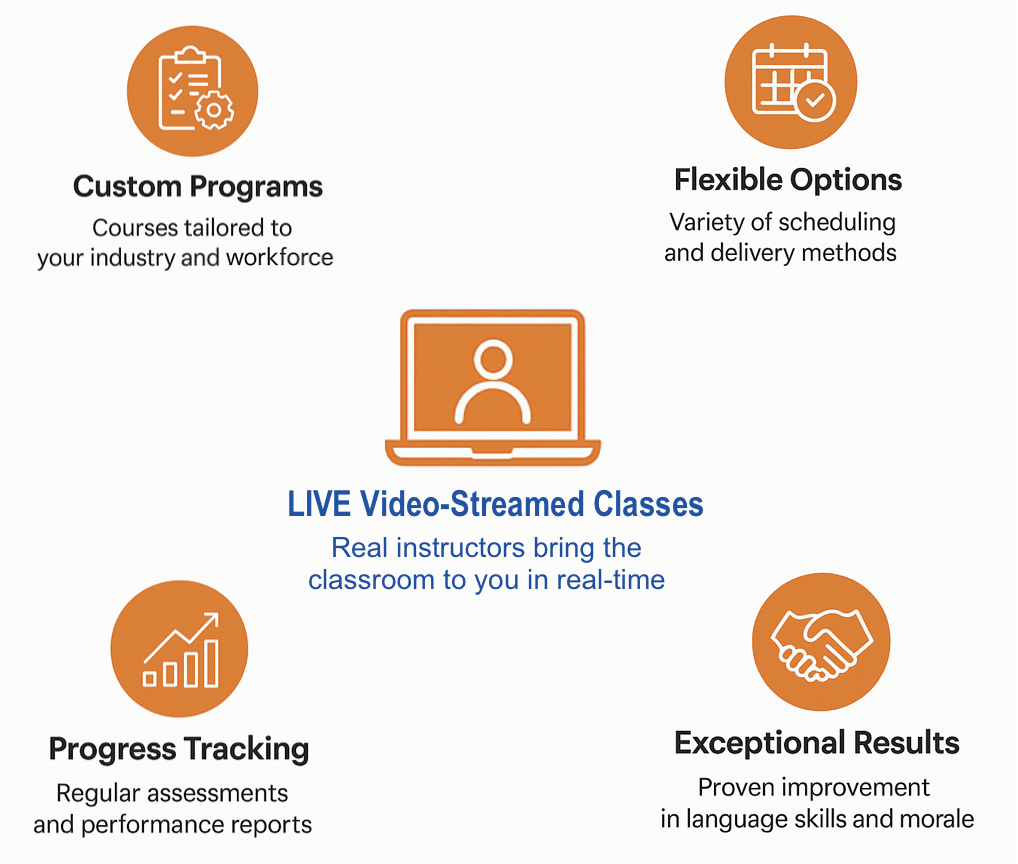
Custom programs focused on your industry, your workforce and your manufacturing processes
LIVE video-streamed classes bring expert instructors to your workplace creating real-time learning
Flexible scheduling options makes attending corporate English training realistic
Experienced instructors ensure that class remains engaging and hold learners accountable
Progress tracking keeps your leadership involved and able to make changes any step of the way
Faster results with relevant trainings that delivers improvements you need
HERE'S HOW TO GET STARTED WITH COMPANY ENGLISH TRAINING:
STEP 1: IDENTIFY YOUR NEEDS
The first step is understanding your particular issues. Identify what you need vs what you want your employees to get out of online language training. Unfortunately, there is no magic wand we can wave to make anyone fluent after a few weeks. However, English courses for employees can make significant improvements you need to see.
STEP 2: CONTACT US FOR GRANT APPLICATION SUPPORT
Contact us and let us know you are interested! Let us know what your goals are, and we can formulate a customized language training plan for your business. Our dedicated team will create a private English training program that is realistic, timely and meets your needs. We will also discuss the grant and provide application assistance.
STEP 3: LET US PROVIDE LANGUAGE TRAINING TO YOUR ASSOCIATES
Business English courses supports employees working in any industry. Whether you need associates to improve their speaking skills for construction safety, or their writing skills for marketing contracts, a corporate English course like ours provides solutions you need to see.
NEED MORE INFORMATION ABOUT OUR CORPORATE ENGLISH TRAINING? NO PROBLEM!
- Client testimonial: hear what a former client had to say about our Business English training services.
- Course duration: there is no simple answer but all English courses for companies follow a general formula.
- Course example: get an idea of what tailored English training courses teach in a specific example of what we can do for your workforce.
- Tracking progress: learn how we assess employee ESL progression in our courses.
- Accessing public grant funding: did you know that there is publicly available grant funds that can finance your workforce language training program?
Our interactive and engaging In-Person and Online Corporate Language Training provides English Classes for Companies online and on-site with live highly qualified native-speaking language instructors. We offer Real-Time Private and Group Corporate English Language Training. Get a Free Quote for your Industry Specific Onsite or Online Corporate English Training for employees.


