
If you run a manufacturing operation in Massachusetts and your production floor includes workers with limited English proficiency, public Workforce Innovation and Opportunity Act (WIOA) funding for English language training is available to support your company. This guide breaks down the two main funding paths Massachusetts manufacturers can use to pay for workplace English classes, explains who qualifies, and walks you through the application process from start to finish.
Overview: How Massachusetts Manufacturers Can Use WIOA Funding
Massachusetts manufacturers can use both federal and state funding to pay for on-site or online English for Speakers of Other Languages (ESOL) classes for their employees. On the federal side, the Workforce Innovation and Opportunity Act - commonly called WIOA - provides Title I incumbent worker training grants administered by regional MassHire Workforce Boards. On the state side, the Workforce Training Fund Program (WTFP), administered by Commonwealth Corporation, offers Express and General grants that name ESOL as a funding priority.
Here is why the terminology gets confusing: employers and HR departments often say "WIOA funding" when they actually mean either a MassHire WIOA incumbent worker grant or a WTFP ESOL grant. Both programs support workforce development for existing employees, but they come from different sources, follow different rules, and have different caps. This guide covers both so you can figure out which one fits your plant.
WIOA was signed into law on July 22, 2014, and it aims to improve coordination between employment services and workforce development programs across the country. In Massachusetts, WIOA funding is administered through the Massachusetts Department of Elementary and Secondary Education for adult education programs, while Title I workforce services flow through MassHire Career Centers. Nationally, WIOA provides English literacy instruction to 1.8 million individuals annually, making it one of the largest sources of language training funding in the United States. Local MassHire Career Centers are the primary access points for WIOA training programs in Massachusetts.
For manufacturers exploring language courses for companies, these grants can offset a significant share of the cost. Whether you need courses tailored to your shop floor or general English courses for employees, public funding makes it financially realistic. Language Training Pro is a Massachusetts-based provider that helps manufacturers design ESOL and workplace communication courses aligned with both WIOA and WTFP requirements - delivered live via Zoom and customizable by facility, shift, and English proficiency level. WIOA funding for English language training can be the funding that opens the door to these educational opportunities.
Why does English language training matter on a manufacturing floor? Because miscommunication costs money and endangers people. Workers who cannot read standard operating procedures, lock-out/tag-out instructions, or safety signage are more likely to make errors that cause injuries, quality defects, and production delays. WIOA emphasizes integrated education and training that links language skills directly with employment goals, and WIOA-funded programs often combine English instruction with job preparation and workplace communication. ESOL programs under WIOA integrate workforce readiness training so that workers are not just learning grammar - they are learning to succeed in their specific roles. This kind of job training also opens career advancement pathways: bilingual line workers can move into lead, quality tech, or safety coordinator positions when their English improves.
WIOA funding for English language training programs include skills training for high-demand industries, and manufacturing is consistently among them. Funding programs generally do not pay students directly but through approved providers, which means the grants flow to qualified training organizations on behalf of your employees.
Here are quick answers to the questions manufacturers ask most often:
- Typical grant sizes: WTFP Express grants reimburse up to $20,000 per company per calendar year (as of recent guidelines), with a per-employee per-course cap of approximately $3,000. WTFP General grants can reach $125,000–$200,000 over two years. WIOA training vouchers can provide up to $12,000 for eligible residents in individual training scenarios.
- Employee eligibility basics: incumbent workers on your payroll (full-time or part-time) are generally eligible for WTFP grants. WIOA incumbent worker grants also target current employees. For individual WIOA programs, eligibility generally includes being 18 or older and legally authorized to work in the U.S.
- Training formats: on-site classroom instruction, live online sessions via Zoom, or blended/hybrid models that work around shift schedules.
- Approximate timeline from application to training start: WTFP Express decisions often come within a few weeks. WIOA incumbent worker grants and WTFP General grants typically take six to twelve weeks from planning through approval and contract execution.
Funding Options: WIOA Title I Incumbent Worker Grants vs. Workforce Training Fund ESOL
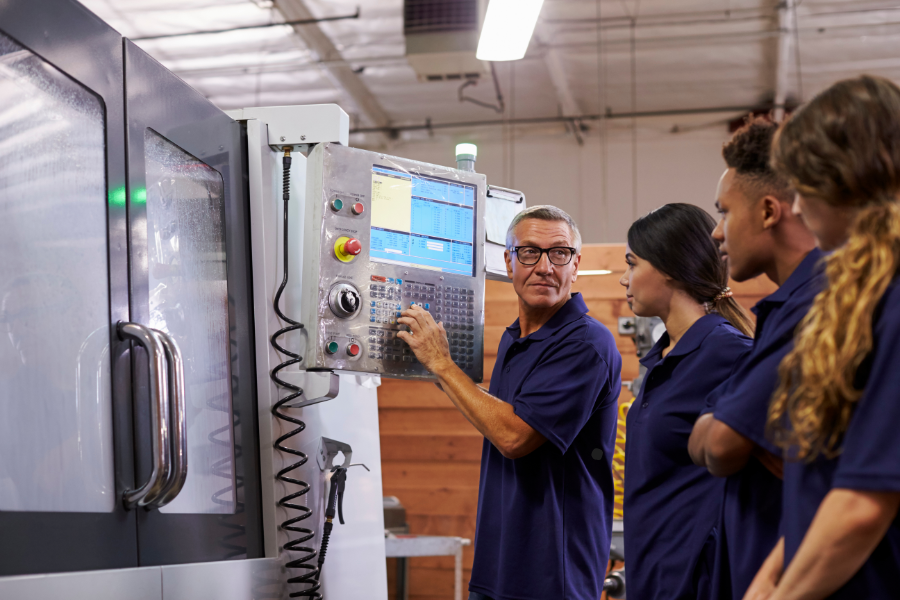
Massachusetts manufacturers generally have two main options for funding English language training: federal Workforce Innovation and Opportunity Title I incumbent worker training, administered through MassHire Workforce Boards, and the state Workforce Training Fund Program, administered by Commonwealth Corporation. Both support ESOL as part of skills training and workforce innovation. The right choice depends on your company size, the scope of training you need, and how quickly you want to get started.
A necessary disclaimer: details such as caps, deadlines, and rules change. This article is based on Massachusetts practices commonly in place through 2025–2026. Always confirm current guidelines with your MassHire Workforce Board or Commonwealth Corporation's WTFP page before submitting an application.
Here is how the two funding paths compare and what each one covers:
- WIOA Title I Incumbent Worker Training is a federal program under the Workforce Innovation and Opportunity Act, known as WIOA in policy documents. These grants are administered locally by MassHire Workforce Boards and career services centers - for example, MassHire Hampden County, MassHire Metro North, MassHire Greater Lowell, or MassHire Berkshire. They are designed to upskill current employees (not new hires) to avert layoffs, support career advancement, or fill critical skill gaps. English language training qualifies when it is tied to specific job performance outcomes such as reading quality checklists, reporting safety incidents, or preparing workers for promotion to supervisory roles. Employers typically must provide a cost-share match, which may be in cash or in-kind (such as wages paid during training hours), with percentages that vary by region and company size.
- WIOA also serves broader populations beyond incumbent workers. WIOA programs serve unemployed and low-income individuals, including unemployed adults, youth, and underemployed workers. The programs prioritize services for low-income adults and individuals with limited English proficiency for training programs. Low-income individuals can qualify as English language learners under WIOA. For youth specifically, Workforce Innovation and Opportunity supports career exploration and guidance: In-School Youth must be aged 14 to 21, while Out-of-School Youth must be aged 16 to 24, and eligible Out-of-School Youth can be school dropouts. Individuals receiving unemployment insurance can access approved training tracks under WIOA as well. WIOA programs aim to connect English learners with job opportunities and vocational training, and job seekers access employment services through their local American Job Center.
- Individual Workforce Innovation and Opportunity training vouchers work differently from employer-driven incumbent worker grants. Eligible individuals receive an Individual Training Account voucher for training, and WIOA training vouchers may cover up to $12,000 for approved education and skills training. To get started with individual WIOA services, contact your local American Job Center for eligibility, and complete a screening form after watching the info session video. These individual pathways are relevant if your employees want to pursue training independently through an online English classes program.
- The Workforce Training Fund Program (WTFP) is financed by Massachusetts employer payroll contributions - a component of the state's unemployment insurance trust fund - and administered statewide by Commonwealth Corporation. ESOL is a stated funding priority. The WTFP Express Program offers faster, rolling-application grants that typically reimburse up to $3,000 per employee per course, with a company-level cap of up to $20,000 per calendar year. Companies with 50 or fewer Massachusetts employees may receive 100% reimbursement; those with 51–100 employees typically receive about 50%. The WTFP General Program supports larger, competitive grants for custom training projects - often up to $125,000–$200,000 over two years - that can bundle multi-level ESOL with technical training, leadership development, and safety programs. In FY 2025, the WTFP program served approximately 28,000 workers and 1,600 businesses across the state.
- A recent policy change benefits manufacturers applying for General Program grants: Commonwealth Corporation now waives the strict dollar-for-dollar match requirement for the ESOL portion of applications. If your grant includes ESOL modules, those modules need not themselves carry a 1:1 match as long as the non-ESOL portions of the application meet the match threshold. This lowers the financial barrier to adding English language training to a broader workforce development plan.
- Which program fits which manufacturer? Workforce Innovation and Opportunity incumbent worker training is the best path when you are already working closely with a local MassHire Business Services representative and want to pair English with broader workforce services such as recruitment, career services, and on-the-job training. WTFP Express is the best fit for small and mid-sized manufacturers (100 or fewer Massachusetts employees) that want reimbursement for straightforward ESL classes during 2026, with a simple online application. WTFP General is the best fit for larger, multi-site manufacturers planning multi-year workforce development strategies that combine ESOL with technical, supervisory, or safety training programs.
- Interpreter Training Programs and Language Training Pro can structure training programs for either funding stream. For WIOA Title I projects, they design courses that tie English language outcomes to specific job training goals - for instance, the ability to complete quality checklists in English, report near-misses using standard department terminology, or participate in daily standup meetings. For WTFP applications, they map industry-specific language courses to the Express or General application template, including schedules adapted to shift work, curricula contextualized to manufacturing tasks, and evaluation methods that satisfy grant reporting requirements.
Step‑by‑Step: How Massachusetts Manufacturers Apply for Workforce Innovation and Opportunity-Funded English Language Training
The application process is manageable when you break it into steps. Most manufacturers work with both a training provider (such as Language Training Pro) and a public partner (a MassHire Workforce Board or Commonwealth Corporation) from first inquiry through contract signing. The path differs slightly depending on whether you pursue WIOA Title I incumbent worker funding or a Workforce Training Fund grant, but the overall sequence is similar.
Below is a chronological walkthrough covering both funding streams, with notes on where they diverge. Workforce Innovation and Opportunity funding supports English literacy instruction for 1.8 million individuals nationally each year, and Massachusetts manufacturers are eligible to access a meaningful share of that investment.
- Step 1 - Confirm Business Eligibility: verify that your company pays into the Massachusetts unemployment insurance system and, for WTFP, the Workforce Training Fund. Most for-profit manufacturers with Massachusetts payroll already do. For WIOA incumbent worker projects, contact your local MassHire Career Center or Workforce Board to ask whether they are currently accepting incumbent worker training proposals for ESOL. Some very small firms or newly opened plants may only be eligible for certain programs, and MassHire Business Services staff can quickly clarify your eligibility. If your individual employees want to pursue training on their own, remind them that eligibility for WIOA programs generally includes being 18 or older and legally authorized to work in the U.S., and that they can visit their local American Job Center to learn more.
- Step 2 - Assess English Training Needs: Work with your HR, operations, and EHS managers to identify specific English skills gaps on the floor. Common examples in manufacturing include reading lock-out/tag-out procedures, understanding quality documentation, filling out incident reports, and participating in continuous improvement or safety meetings. A quick internal needs assessment - gathering supervisor feedback, reviewing safety and quality data, and collecting employee self-assessments - gives you the information you need to select the right training level.
- Step 3 - Contact Public Partners: for WIOA, reach out to your local MassHire Career Center or Workforce Board (examples include MassHire Metro North in Cambridge, MassHire Greater Brockton, or MassHire Central in Worcester) and ask specifically about "WIOA Title I incumbent worker training grants for English language training." For WTFP, visit Commonwealth Corporation's Workforce Training Fund Program website to review current Express and General guidelines, deadlines, and ESOL-specific guidance. Some regions have additional local manufacturing partnerships or sector initiatives that can co-fund language training - your MassHire contact can point you to these. Do not hesitate to ask questions about match requirements, approved providers, and current funding availability in your area.
- Step 4 - Design the Training Program with a Provider: the employer and provider should co-design a course outline that includes a course title, learning objectives, total contact hours, schedule (for example, two sessions per week for twelve weeks), delivery method (on-site at your facility or live via Zoom), an assessment plan, and expected outcomes tied to workforce development goals. Language Training Pro specializes in corporate language courses for manufacturing, logistics, and technical environments and can adapt curriculum to shift schedules and production cycles.
- Step 5 - Prepare and Submit the Application: for WIOA, you will work with a MassHire case manager or business representative to complete an incumbent worker training proposal. This typically includes employer match documentation, a list of enrolled employees with their wages and job titles, and the training schedule. For WTFP Express, the application is submitted online through the Workforce Training Fund portal - you upload the course outline, provider hourly rates, total tuition per employee, number of participants, and a brief narrative tying the course to business outcomes like productivity, retention, and safety improvement. For WTFP General, applications are more detailed: they require a broader workforce plan, letters of support from partners, a multi-year budget, and an evaluation plan, with fixed submission deadlines several times per year. Your training provider can supply most of the curriculum and scheduling details you need for any of these applications.
- Step 6 - Approval, Contracting, and Launch: Express decisions typically arrive within a few weeks. WIOA incumbent worker grants and General Program applications may take several weeks to a few months depending on review cycles. Once approved, your company signs a grant agreement and schedules classes. Reimbursement usually follows training completion, contingent on submission of attendance records, invoices, and a brief outcome report. To maximize participation and minimize production disruption, consider building training around shift overlaps, before or after production hours, or during scheduled maintenance windows. People learn best when the pace of instruction matches their work rhythms.
- Step 7 - Measure Results and Plan Next Cohorts: track both language gains (pre- and post-assessments, instructor evaluations) and business outcomes. The metrics that matter most to grant reviewers and to your own bottom line include reduction in safety incidents linked to miscommunication, improvement in first-pass quality rates, lower turnover among trained workers, and the number of employees who receive promotions or new certifications after completing the program. Use these results when reapplying for additional funding cycles or expanding training to new facilities or departments. Strong outcomes data also helps you find new adult education and support services partnerships for future cohorts. Manufacturers that can demonstrate clear benefits from their initial grant are far more likely to secure ongoing funding.
Massachusetts has made ESOL for Work an explicit state priority, with $10 million proposed under the Healey-Driscoll administration to scale workplace English programs. Whether you are looking to ensure compliance, reduce barriers to promotion, or simply help your team work more safely, funded English language training is one of the highest-return investments a manufacturer can make.
If you are a Massachusetts manufacturer ready to enter the application process for WIOA funding for English language training, start by identifying your training needs and selecting the right funding path. Then connect with a provider who understands both the grant requirements and the realities of manufacturing operations.
Ready to start using WIOA funding for English language training? Schedule a brief consultation with Language Training Pro to map out your first ESOL project aligned with Workforce Innovation and Opportunity or Workforce Training Fund goals. Their team can help you search for the right grant fit, design a curriculum your employees will actually use, and handle the documentation so you can stay focused on production. Send them an email or visit their homepage to get started - they are happy to answer your questions and walk you through the process at whatever pace works for your team.
Contact Language Training Pro at +1 (617) 731-3700, email training@languageconnections.com, or request a free quote online - no obligation, customized to your plant.