
If you run a manufacturing operation in Massachusetts and your production floor includes workers with limited English proficiency, public funding for English language training is available to help. This guide breaks down the two main funding paths Massachusetts manufacturers can use to pay for workplace English classes, explains who qualifies, and walks you through the application process from start to finish.
Overview: How Massachusetts Manufacturers Can Use WIOA Funding
Massachusetts manufacturers can use both federal and state funding to pay for on-site or online English for Speakers of Other Languages (ESOL) classes for their employees. On the federal side, the Workforce Innovation and Opportunity Act (WIOA) provides Title I incumbent worker training grants, administered by regional MassHire Workforce Boards. On the state side, the Workforce Training Fund Program (WTFP), administered by Commonwealth Corporation, offers Express and General grants that name ESOL as a funding priority.
Here's why the terminology gets confusing: employers and HR departments often say "WIOA funding" when they actually mean either a MassHire WIOA incumbent worker grant or a WTFP ESOL grant. Both programs support training for existing employees, but they come from different sources, follow different rules, and have different caps. This guide covers both so you can figure out which one fits your plant.
WIOA was signed into law on July 22, 2014, to improve coordination between employment services and workforce development programs nationwide. In Massachusetts, WIOA adult education funding is administered through the Department of Elementary and Secondary Education, while Title I workforce services flow through MassHire Career Centers, which are the main access points for WIOA training programs.
Whether you need language courses built for your industry or general English courses for employees, public funding can make workplace English training financially realistic. Language Training Pro is a Massachusetts-based provider that helps manufacturers design ESOL and workplace communication courses aligned with both WIOA and WTFP requirements, delivered on-site at your facility or live online, and customized by facility, shift, and English proficiency level.
Why English Language Training Matters on the Manufacturing Floor
English language training matters because miscommunication costs money and puts people at risk. Workers who can't read standard operating procedures, lockout/tagout instructions, or safety signage are more likely to make errors that lead to injuries, quality defects, and production delays.
WIOA emphasizes integrated education and training that connects language skills directly to employment goals. That means ESOL programs funded this way aren't just grammar lessons. They help workers succeed in their specific roles. Workplace English also opens career pathways: bilingual line workers can move into lead, quality technician, or safety coordinator positions as their English improves.
Funding programs generally don't pay workers directly. Instead, grants flow through approved training providers on behalf of your employees.
Quick Answers for Manufacturers
- Typical grant sizes: WTFP Express grants reimburse up to $3,000 per employee per course, with an annual cap of $15,000 per employer. WTFP General grants can reach up to $200,000 over two years. Individual WIOA training vouchers can cover up to around $12,000 for eligible residents, though amounts vary by region.
- Employee eligibility: Current employees on your Massachusetts payroll (full-time or part-time) are generally eligible for WTFP grants, and WIOA incumbent worker grants also target current employees. Contractors and temporary staff typically aren't eligible.
- Training formats: On-site classroom instruction, live online sessions via Zoom, or blended models that work around shift schedules.
- Timeline: WTFP Express applications must be submitted at least 21 days before training begins, and decisions are typically issued within 60 days. WIOA incumbent worker grants and WTFP General grants often take six to twelve weeks from planning through approval and contract signing.
Funding Options: WIOA Title I Incumbent Worker Grants vs. the Workforce Training Fund
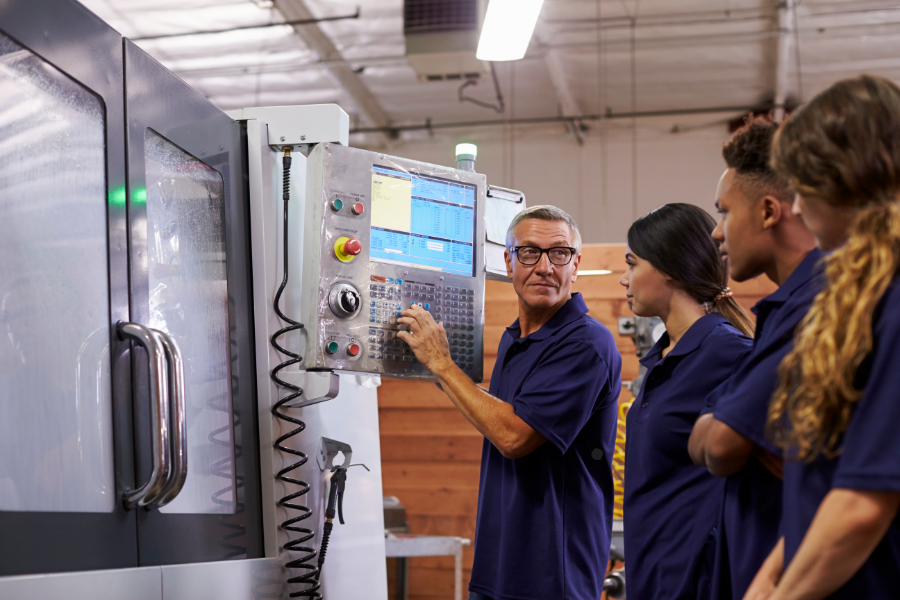
Massachusetts manufacturers generally have two main options for funding English language training. The right choice depends on your company size, the scope of training you need, and how quickly you want to get started.
A quick note: caps, deadlines, and rules change. Always confirm current guidelines with your MassHire Workforce Board or Commonwealth Corporation's WTFP page before applying.
WIOA Title I Incumbent Worker Training
WIOA Title I incumbent worker grants are federal funds administered locally by MassHire Workforce Boards, such as MassHire Hampden County, MassHire Metro North, MassHire Greater Lowell, and MassHire Berkshire. These grants are designed to upskill current employees to avert layoffs, support career advancement, or fill critical skill gaps.
English language training qualifies when it's tied to specific job performance outcomes, such as reading quality checklists, reporting safety incidents, or preparing workers for supervisory roles. Employers typically provide a cost-share match, which can be cash or in-kind (such as wages paid during training hours). Match percentages vary by region and company size.
Individual WIOA Training Accounts
WIOA also serves individuals directly, including unemployed and low-income adults and people with limited English proficiency. Eligible individuals can receive an Individual Training Account voucher for approved education and skills training. If an employee wants to pursue training independently, they can contact their local MassHire Career Center or American Job Center to learn about eligibility, which generally includes being 18 or older and legally authorized to work in the U.S.
The Workforce Training Fund Program (Express and General)
The WTFP is financed by Massachusetts employer contributions to the state's unemployment insurance system and administered statewide by Commonwealth Corporation. ESOL is a stated funding priority, and in FY 2025, the program served approximately 28,000 workers at 1,600 businesses across the state.
The Express Program offers faster, rolling-application grants for employers with 100 or fewer Massachusetts employees. As of April 1, 2026, eligible companies can receive 100% reimbursement for approved courses, up to $3,000 per employee per course and $15,000 per employer each calendar year. Learn more in our guide to 100% ESOL reimbursement for Massachusetts manufacturers.
The General Program supports larger, competitive grants for custom training projects of up to $200,000 over two years. These can bundle multi-level ESOL with technical training, leadership development, and safety programs. The General Program normally requires a dollar-for-dollar employer match, but Commonwealth Corporation waives the match for the ESOL portion of an application, which lowers the financial barrier to adding English training to a broader workforce plan. For more detail, see our guide to using Incumbent Worker Training grants for ESOL classes.
Which Program Fits Your Plant?
WIOA incumbent worker training is the best path if you already work with a local MassHire Business Services representative and want to pair English training with broader workforce services, such as recruitment and on-the-job training. WTFP Express is the best fit for small and mid-sized manufacturers with 100 or fewer Massachusetts employees that want reimbursement for straightforward ESOL classes with a simple online application. WTFP General is the best fit for larger or multi-site manufacturers planning multi-year strategies that combine ESOL with technical, supervisory, or safety training.
Language Training Pro can structure programs for any of these funding streams. For WIOA projects, we design courses that tie English outcomes to specific job goals, like completing quality checklists in English, reporting near misses using standard terminology, or participating in daily stand-up meetings. For WTFP applications, we map industry-specific English training to the Express or General requirements, including shift-friendly schedules, manufacturing-focused curriculum, and the evaluation methods grant reporting requires.
Step-by-Step: How to Apply for Funded English Language Training
Most manufacturers work with both a training provider and a public partner (a MassHire Workforce Board or Commonwealth Corporation) from first inquiry through contract signing. The steps differ slightly between WIOA and WTFP, but the overall sequence is similar.
- Confirm business eligibility. Verify that your company pays into the Massachusetts unemployment insurance system, which also funds the WTFP. Most for-profit manufacturers with Massachusetts payroll already do. For WIOA incumbent worker projects, ask your local MassHire Career Center or Workforce Board whether they're currently accepting incumbent worker training proposals for ESOL.
- Assess your English training needs. Work with HR, operations, and EHS managers to identify specific skills gaps on the floor, such as reading lockout/tagout procedures, understanding quality documentation, filling out incident reports, or participating in safety meetings. Supervisor feedback, safety and quality data, and employee self-assessments all help you choose the right training level.
- Contact your public partners. For WIOA, reach out to your local MassHire Workforce Board (such as MassHire Metro North, MassHire Greater Brockton, or MassHire Central) and ask specifically about "WIOA Title I incumbent worker training grants for English language training." For the WTFP, review Commonwealth Corporation's current Express and General guidelines and deadlines. Your MassHire contact may also know of local manufacturing partnerships that can co-fund training.
- Design the training program with a provider. Work with your provider on a course outline that includes learning objectives, total contact hours, schedule (for example, two sessions per week for twelve weeks), delivery method (on-site or live online), an assessment plan, and expected outcomes tied to your business goals.
- Prepare and submit your application. For WIOA, you'll typically work with a MassHire business representative on an incumbent worker training proposal that includes match documentation, a list of participating employees, and the training schedule. For WTFP Express, you'll apply online with the course details, costs, number of participants, and a brief narrative connecting training to business outcomes like safety, productivity, and retention. WTFP General applications are more detailed and follow fixed deadlines. Your training provider can supply most of the curriculum and scheduling details.
- Get approved, sign your agreement, and launch. Training can't start until your application is approved. Once it is, you'll sign a grant agreement and schedule classes. Reimbursement usually follows training completion, once you submit attendance records, invoices, and a brief outcome report. Scheduling classes around shift overlaps, before or after production hours, or during maintenance windows helps maximize attendance without disrupting production.
- Measure results and plan your next cohort. Track both language gains (pre- and post-assessments and instructor evaluations) and business outcomes, such as fewer communication-related safety incidents, better first-pass quality, lower turnover among trained workers, and internal promotions. Strong results help you secure funding for future cohorts and expand training to new departments or facilities.
Massachusetts has made workplace English an explicit priority. In July 2025, the state celebrated a $10 million investment included in the Fair Share supplemental budget to expand workforce training access and reduce waitlists for ESOL services. Whether your goal is safer operations, stronger compliance, or clearer paths to promotion, funded English language training is one of the highest-return investments a manufacturer can make. mass
Ready to start using WIOA funding for English language training? Language Training Pro can help you map out your first ESOL project, find the right grant fit, design a curriculum your employees will actually use, and handle the documentation so you can stay focused on production. Request a free quote online - no obligation, customized to your plant.
Frequently Asked Questions
What is WIOA funding for English language training?
The Workforce Innovation and Opportunity Act (WIOA) is a federal law that funds workforce training, including English language instruction. In Massachusetts, employers can access WIOA Title I incumbent worker training grants through their regional MassHire Workforce Board to help pay for English classes for current employees.
What's the difference between WIOA grants and the Workforce Training Fund Program?
WIOA incumbent worker grants are federal funds administered locally by MassHire Workforce Boards. The Workforce Training Fund Program (WTFP) is a state program funded by Massachusetts employer contributions and administered by Commonwealth Corporation. Both can pay for ESOL training for existing employees, but they have different rules, caps, and application processes.
Which Massachusetts employers qualify for ESOL training funding?
Most for-profit Massachusetts employers that pay into the state's unemployment insurance system are eligible for the Workforce Training Fund. For WIOA incumbent worker grants, eligibility and availability vary by region, so check with your local MassHire Workforce Board.
Do employers have to match the grant funding?
It depends on the program. WIOA incumbent worker grants typically require an employer cost-share, which can include wages paid during training. The WTFP General Program normally requires a dollar-for-dollar match, but Commonwealth Corporation waives that match for the ESOL portion of an application.
How do I apply for WIOA-funded English training?
Contact your local MassHire Career Center or Workforce Board and ask about WIOA Title I incumbent worker training grants for English language training. For the Workforce Training Fund, review the current guidelines on Commonwealth Corporation's website. A training provider can help you prepare the course outline, schedule, and budget for your application.
How long does it take to get approved for funding?
WTFP Express decisions often come within a few weeks. WIOA incumbent worker grants and WTFP General grants typically take six to twelve weeks from planning through approval and contract signing. Training can't start until your application is approved.
Can funded English training happen on-site or online?
Yes. Funded ESOL training can be delivered on-site at your facility, live online via Zoom, or as a blended program, with schedules built around shifts and production cycles.